
Author: Marketing Digital Emidas
Dental Accuracy Review: Vaksman Dental Group Clinical Team
Last Updated: July 7, 2026
Dental symptoms are not always easy to understand. A toothache may feel like simple sensitivity, but it can sometimes point to a deeper problem inside the tooth. A small chip may look cosmetic, but it can affect the way your smile feels and functions. Deep grooves in the back teeth may increase cavity risk even when you brush regularly. A tooth that already had root canal treatment may still need attention if swelling or infection returns near the root tip.
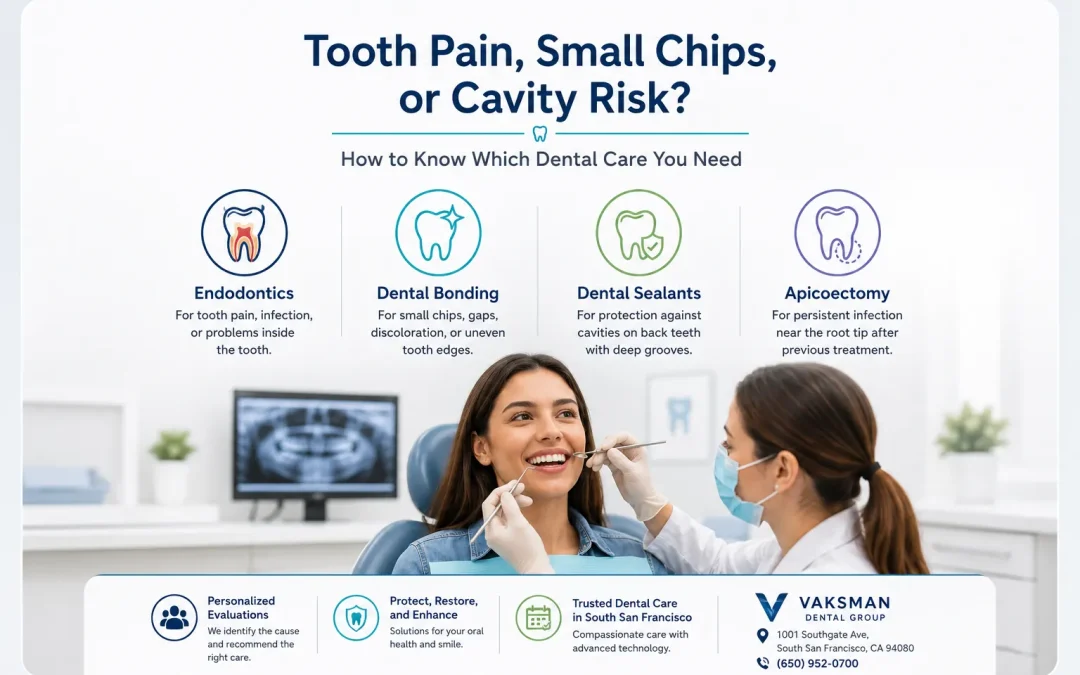
Quick Answer: If you have severe tooth pain, lingering sensitivity, or swelling near one tooth, you may need endodontic care. If you have a small chip, minor gap, or uneven tooth edge, cosmetic dental bonding may help. If your molars have deep grooves or higher cavity risk, dental sealants may provide preventive protection. If a previously treated tooth still has infection near the root tip, an apicoectomy evaluation may be needed.
Vaksman Dental Group helps patients in South San Francisco understand which dental treatment may be right for their symptoms, oral health, and long-term smile goals.
Contenido
Which Dental Treatment Matches Your Symptoms?
| Symptom or Concern | Possible Treatment | Best Next Step |
|---|---|---|
| Severe tooth pain, lingering sensitivity, or pain when biting | Endodontics | Schedule an exam and X-rays |
| Small chip, gap, uneven edge, or minor cosmetic concern | Cosmetic dental bonding | Request a cosmetic evaluation |
| Deep grooves on molars or higher cavity risk | Dental sealants | Ask about preventive protection |
| Gum bump, swelling, or pain after previous root canal treatment | Apicoectomy | Evaluate the root tip and surrounding tissue |
The right treatment depends on the cause of the problem. A dental exam is the best way to understand whether your symptoms are related to decay, infection, tooth structure, bite pressure, cosmetic damage, or cavity risk.
When Tooth Pain May Need Endodontic Care
Tooth pain is one of the most common reasons people look for a dentist in South San Francisco. Some discomfort may come from a cavity, damaged filling, gum irritation, or bite pressure. However, pain that feels deep, sharp, persistent, or connected to swelling may involve the inside of the tooth.
The inner part of the tooth contains dental pulp, nerves, blood vessels, and the root canal system. When this area becomes inflamed, infected, or damaged, endodontic care may be recommended.
You may need endodontics in South San Francisco if you notice:
- Severe toothache
- Lingering sensitivity to hot or cold
- Pain when biting or chewing
- Gum swelling near one tooth
- A cracked, fractured, or deeply decayed tooth
- Tooth discoloration after trauma
- A pimple-like bump on the gums
- Discomfort around a tooth that had previous dental treatment
Endodontics focuses on diagnosing and treating problems inside the tooth. Root canal treatment is one of the most common endodontic procedures and may help preserve the natural tooth when the tooth can still be restored.
Answer-first summary: Endodontic care may be needed when pain, infection, or inflammation affects the inner part of the tooth. The goal is to relieve discomfort, treat the source of infection, and help save the natural tooth when possible.
When a Small Chip, Gap, or Uneven Tooth May Need Dental Bonding
Not every dental concern begins with pain. Many patients visit the dentist because they notice something about their smile that bothers them, such as a small chip, rough edge, minor gap, uneven tooth shape, or discoloration.
Cosmetic dental bonding uses tooth-colored composite resin to repair or reshape selected areas of a tooth. The material is placed, shaped, hardened, and polished so it blends with the surrounding smile.
A consultation for cosmetic dental bonding in South San Francisco may be helpful if you have:
- A small chip on a front tooth
- A minor gap between teeth
- Uneven tooth edges
- Slight discoloration
- A tooth that looks shorter than nearby teeth
- A small surface defect
- Mild cosmetic asymmetry
- A tooth that does not visually match the rest of your smile
Dental bonding is often considered a conservative cosmetic option because it can improve the appearance of a tooth while preserving healthy tooth structure. However, it may not be the right treatment for every case.
If a tooth has deep decay, a large fracture, heavy bite pressure, or significant structural damage, your dentist may recommend another option such as a veneer, crown, orthodontic treatment, or restorative care.
Answer-first summary: Cosmetic dental bonding may be a good option for small chips, minor gaps, uneven edges, and mild cosmetic concerns when the tooth is healthy enough to support bonding material.
When Dental Sealants Can Help Reduce Cavity Risk
Some teeth are naturally harder to clean than others. Molars and premolars often have grooves, pits, and narrow chewing surfaces where food particles and bacteria can collect. Even with consistent brushing, these areas may remain vulnerable to cavities.
Dental sealants are thin protective coatings placed on selected chewing surfaces. They help cover deep grooves so food and plaque are less likely to settle into those areas.
You may want to ask about dental sealants in South San Francisco if you or your child have:
- Deep grooves on back teeth
- Newly erupted permanent molars
- A history of cavities
- Difficulty cleaning chewing surfaces
- Food that often gets trapped in molars
- Higher cavity risk
- A need for added preventive protection
Sealants are common for children and teens, especially when permanent molars come in, but some adults may also benefit if their teeth are healthy and have deep grooves that are vulnerable to decay.
Dental sealants do not replace brushing, flossing, regular exams, fluoride, or professional cleanings. Instead, they are part of a preventive dental plan designed to protect specific teeth from decay.
Answer-first summary: Dental sealants may help reduce cavity risk on selected back teeth by covering deep grooves and making chewing surfaces easier to keep clean.
When a Previously Treated Tooth May Need an Apicoectomy
Sometimes, a tooth that has already received endodontic treatment may continue to cause symptoms. You may notice tenderness when biting, swelling near the gums, a recurring bump, or discomfort around the root area.
When inflammation or infection remains near the tip of a tooth root, a dentist may recommend an apicoectomy evaluation. An apicoectomy is a surgical dental procedure focused on the root tip and the surrounding tissue.
A consultation for an apicoectomy in South San Francisco may be appropriate if you have:
- Persistent discomfort near one tooth
- Swelling near the gumline
- A small bump or drainage area on the gums
- Tenderness when biting or chewing
- Root-end inflammation visible on dental imaging
- Symptoms that return after previous endodontic treatment
- A tooth that may still be restorable
- A desire to preserve the natural tooth when possible
Not every painful or previously treated tooth needs an apicoectomy. Some cases may require monitoring, retreatment, restoration, referral, or extraction if the tooth cannot be saved. The recommendation depends on the tooth condition, previous treatment, X-rays, symptoms, and overall oral health.
Answer-first summary: An apicoectomy may be considered when infection or inflammation remains near the root tip after previous endodontic care and the tooth may still be saved.
How These Dental Treatments Work Together
Endodontics, bonding, sealants, and apicoectomy care may seem unrelated, but they all support long-term oral health in different ways.
Endodontics helps treat pain or infection inside the tooth. Cosmetic dental bonding repairs small visible imperfections. Dental sealants help prevent cavities on vulnerable chewing surfaces. Apicoectomy care may help address persistent root-end infection after previous treatment.
These services also show why diagnosis matters. The same symptom can have more than one possible cause. Pain when biting could come from a cracked tooth, deep decay, infection, a high filling, bite pressure, or root inflammation. A small chip may be simple to bond, but it may require a different treatment if the tooth is weakened or the bite places too much pressure on that area.
A dentist in South San Francisco can evaluate your teeth, gums, bite, symptoms, and X-rays to recommend the most appropriate treatment.
Signs You Should Schedule a Dental Visit
You should consider scheduling a dental visit if you notice:
- Tooth pain that lasts more than one or two days
- Lingering sensitivity to hot or cold
- Pain when chewing
- Gum swelling near one tooth
- A chipped, rough, or uneven tooth
- A small gap or cosmetic concern that affects your confidence
- Food frequently getting trapped in back teeth
- A recurring gum bump
- Discomfort around a tooth that had previous dental treatment
- Deep grooves on a child’s permanent molars
Early evaluation can often make treatment more straightforward. Waiting may allow decay, infection, or structural damage to become more serious.
What to Expect During Your Dental Evaluation
A dental evaluation helps identify the source of your concern. Depending on your symptoms, your visit at Vaksman Dental Group may include:
- A review of your dental history
- A discussion of your symptoms
- A visual exam of your teeth and gums
- X-rays when needed
- Bite evaluation
- Tooth sensitivity testing
- Assessment of existing fillings or restorations
- Review of cosmetic goals
- Preventive care recommendations
For tooth pain, the dentist may evaluate whether the pulp, root, or surrounding tissue is involved. For cosmetic concerns, the dentist may assess enamel, tooth shape, bite pressure, and smile balance. For cavity prevention, the dentist may review groove depth, hygiene habits, and decay risk.
Why the Right Diagnosis Matters
Dental care should not be based on guesswork. A symptom that feels minor may need treatment, while a concern that seems serious may have a simple solution. The purpose of a dental consultation is to understand the cause of the issue before recommending care.
For example, a chipped tooth may be treated with bonding if the damage is small and the tooth is healthy. But if the chip is caused by grinding, bite pressure, or structural weakness, the dentist may need to address the underlying cause as well.
Similarly, tooth pain may require endodontic care if the inside of the tooth is affected. However, pain may also come from a cracked tooth, gum inflammation, sinus pressure, or bite imbalance. X-rays and clinical testing help guide the correct recommendation.
Protecting Your Teeth at Every Stage
Good dental care is not only about fixing problems after they appear. It also includes preventing cavities, preserving natural teeth, protecting tooth structure, and improving smile confidence in a healthy way.
Endodontics may help save a painful or infected tooth. Cosmetic dental bonding may improve small smile concerns. Dental sealants may reduce cavity risk in vulnerable molars. Apicoectomy care may help address root-end symptoms when a previously treated tooth still has inflammation or infection.
Each treatment has a different role, but the goal is the same: healthier, more comfortable, and more confident smiles.
Schedule a Dental Consultation in South San Francisco
If you have tooth pain, a small chip, cavity concerns, or symptoms near a previously treated tooth, Vaksman Dental Group can help you understand your options.
Schedule a consultation with Vaksman Dental Group in South San Francisco to receive a personalized evaluation and learn which dental treatment may be right for your needs.
Educational Disclaimer: This article is for general educational purposes only and does not replace a dental exam, diagnosis, or personalized treatment recommendation from a licensed dental professional.
FAQs
How do I know if tooth pain needs endodontic treatment?
Tooth pain may need endodontic evaluation if it is severe, persistent, triggered by biting, connected to swelling, or accompanied by lingering hot or cold sensitivity. A dentist can use an exam and X-rays to determine whether the inside of the tooth is affected.
Is cosmetic dental bonding good for chipped teeth?
Cosmetic dental bonding may be a good option for small chips, uneven edges, minor gaps, or slight discoloration. The tooth must be healthy enough to support bonding material.
Are dental sealants only for children?
No. Dental sealants are commonly recommended for children and teens, especially when permanent molars come in, but adults with healthy teeth and deep grooves may also benefit from sealants.
What is the difference between endodontics and apicoectomy?
Endodontics is the broader area of dentistry focused on problems inside the tooth, including root canal treatment. An apicoectomy is a surgical procedure that may be considered when infection or inflammation remains near the tip of the root after previous endodontic care.
Can dental sealants prevent every cavity?
No. Dental sealants can help protect selected chewing surfaces, but they do not replace brushing, flossing, dental exams, fluoride, or professional cleanings.
Should I ignore a small gum bump if it does not hurt?
No. A gum bump near one tooth may be related to infection or drainage. Even if it is not painful, it should be evaluated by a dentist.
Can bonding fix all cosmetic dental problems?
No. Bonding is best for minor cosmetic concerns. More complex issues may require veneers, crowns, orthodontics, or restorative treatment.
What should I do if a tooth hurts after previous dental treatment?
Schedule a dental evaluation. Pain after previous dental treatment may be related to bite pressure, reinfection, a crack, root-end inflammation, or another issue that needs diagnosis.
Are these dental treatments painful?
Most dental treatments are planned with patient comfort in mind. Local anesthesia may be used when needed, especially for endodontic or surgical procedures.
What is the first step if I am unsure which treatment I need?
The first step is a dental consultation. Your dentist can evaluate your symptoms, review X-rays if needed, and explain which treatment options are appropriate.